What an AI Agent Actually Does for a Small Business
Every enquiry you miss after hours is a customer someone else answered. Here is what an AI agent really does for a small business, in plain English, and what it will never do for you.
Every week brings another tool you are supposed to be using already. Here is a way to decide what your business actually needs, in one afternoon, using nothing more expensive than a list of the work you already do.

You have probably been told, several times this year, that your business needs AI. Rarely by someone who could say which part of your business, or what it would replace, or how you would know afterwards whether it worked. That is not a strategy, it is a mood. An AI strategy for a small business is something much smaller and much more useful: a short list of jobs you have decided to stop doing by hand, in the order you intend to stop doing them.
This guide is the method we use with owners who have between two and thirty people, no in-house technical team, and no appetite for a six month project. It takes an afternoon, it costs nothing to run, and it usually ends with three candidates and one decision.
Large companies write AI strategies because they have to coordinate hundreds of people around a shared bet. You do not have that problem. Your constraint is not alignment, it is attention: you can seriously change one thing at a time, and only if it does not break the week while you change it.
So the useful version of the document is four lines long. What is the job. Who does it today. What replaces them doing it. How we will know in ninety days. Anything longer than that is a plan you will not read again, and plans you do not read again do not change anything.
If your strategy cannot be said out loud in one breath, in language a new employee would understand, it is not a strategy yet. "We are going to stop typing the first reply to every enquiry" is a strategy. "We are going to leverage AI across the customer journey" is a wish.
The most common mistake is starting at the wrong end: reading about what a tool can do, then hunting your business for somewhere to put it. That gets you a subscription and no change in how the week feels. Reverse it. The week you already have is the brief.
Not the job description version. The real one: the twenty minutes on the phone confirming an appointment, the reply retyped for the ninth time, the number copied from one app into another, the Monday spreadsheet. Do it for one ordinary week, on paper, as it happens. Recalling it later always flatters you.
Put a mark next to anything that happened more than twice in the same shape. Repetition is the whole signal. A task that varies every time needs judgement and is a poor first candidate. A task you could describe to a new hire on day one is an excellent one.
Some of that repeated work sits directly between a stranger and a paying customer: the first reply, the quote, the booking, the follow-up, the review request. Some of it does not: filing, tidying, formatting. Both are worth fixing eventually. Only the first kind pays you back fast enough to fund the rest.
What is left after those three passes is your real shortlist, and it will usually surprise you. Owners tend to arrive convinced the answer is a chatbot on the website, and leave having realised the expensive problem was that quotes go out two days late.
Across the businesses we work with, almost everything worth doing falls into one of four buckets. They are ordered here roughly the way we would sequence them, because each one makes the next one worth more.
There is no point automating your replies if nothing arrives to reply to. A growing share of people never reach a list of links at all: they ask, they get an answer, they act on it. Making your business legible to those systems is now part of being visible at all, which we cover in getting found when AI answers first.
The hours between an enquiry and a reply are where most small businesses quietly lose work, and no amount of discipline fixes it, because you were busy earning. An AI agent that handles the first conversation answers the routine questions, takes the details, and hands you a person who is already halfway qualified.
Confirmations, reminders, the quote nobody chased, the invoice that went quiet, the review you never asked for. Individually trivial, collectively a part-time job. This is ordinary small business automation, and it is usually the cheapest money on the table.
The Monday morning export-paste-total ritual, or worse, the numbers you never look at because assembling them is a chore. A small custom tool that pulls the same figures into the same shape every week changes decisions, because you finally see the trend rather than the last thing that happened.
Notice that none of these is "add AI to the product". At your size the returns are in the operations, not the offering. That is not a lesser ambition, it is where the hours and the lost revenue actually live.
You now have a shortlist and four buckets. To get from there to a single decision, score each candidate out of five on four questions. No spreadsheet required, and honestly, no great precision required either: the winner is usually obvious once the questions are asked out loud.
Pick the highest score. Then, and this is the part people skip, write down what would make you call it a failure. "Still doing this by hand in November" is a fine definition. Without one you will keep a mediocre change alive out of politeness to your own decision.
Anything that requires every member of staff to change how they work on day one, and anything whose value depends on data you do not currently collect. Both are sometimes worth doing. Neither is a first move, because both fail for reasons that have nothing to do with whether the idea was good.
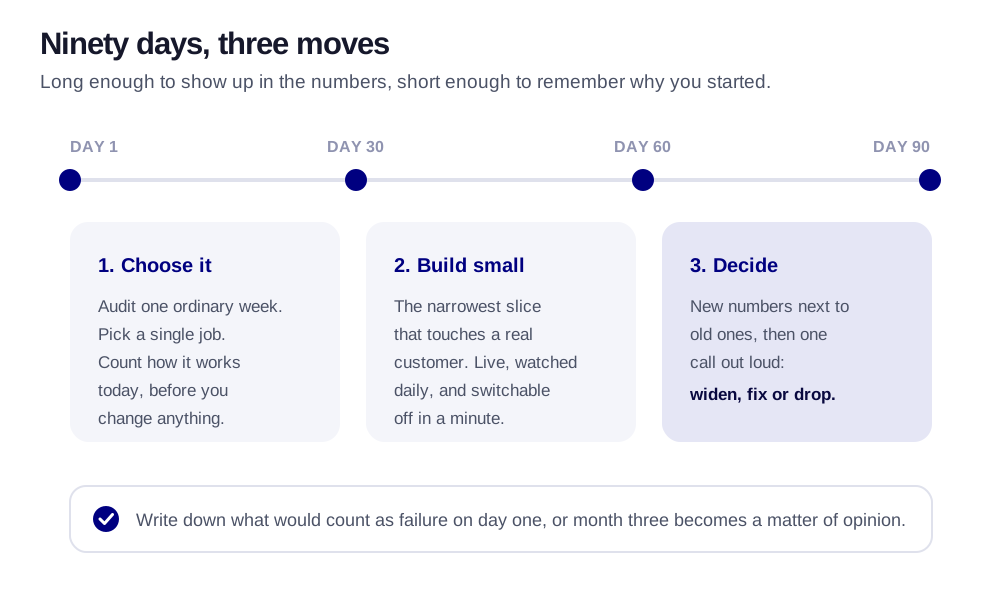
Ninety days is long enough for a real change to show up in the numbers and short enough that you will still remember why you started. Split it into three.
Do the week audit, pick the one job, and then measure the current state before you change anything. How many enquiries came in, how long did the first reply take, how many quotes went out, how many were chased. Rough counts on paper are fine. Skipping this is the single most common reason people cannot tell later whether it worked.
Not the complete system. The narrowest slice that touches a real customer: one channel, one type of enquiry, one reminder. Small enough to switch off in a minute if it misbehaves. Run it live, watch it daily for the first week, and keep a note of every case where you had to step in.
Put the new numbers next to the old ones and make one of three calls: keep it and widen it, fix the one thing holding it back, or drop it and take the next candidate. Deciding out loud matters. A thing nobody ever decided about keeps consuming attention forever.
A good strategy is as clear about what it will not touch. In a small business your advantage over larger competitors is that a customer can reach someone who knows the answer and can make a decision. Automating that away to save a few minutes is a poor trade at any price.
The failures are boringly consistent, which is good news, because it makes them easy to avoid.
Software makes an existing process faster and more consistent, including a bad one. If the current version confuses customers, you are about to confuse them at scale. Fix the shape first, on paper, then hand it over.
Enthusiasm spends easily. Five half-configured subscriptions produce five monthly charges and no change in the week. Finish one, in full, before the second one is allowed to exist.
Every automated thing needs one named person who notices when it stops. Not a committee, and not "we will all keep an eye on it", which reliably means nobody does.
The worst outcome is not an automation that breaks. It is one that breaks quietly in June and gets discovered in August. Anything that runs on your behalf should tell you when it did not, or at least tell you weekly that it did.
Without a rough baseline, every result is a matter of opinion, and opinions about your own decisions are generous. Ten minutes of counting in week one settles arguments in month three.
If this works, the change is not dramatic and it does not look like the brochure. Enquiries get answered while you are still holding a drill. Quotes go out the same day and get chased without you feeling like a nuisance. Monday's numbers are in your inbox before you open the laptop. Reviews arrive because someone asked at the right moment, and the businesses that get recommended are the ones with reviews to recommend.
None of that is a robot running your company. It is three or four small handovers, chosen in the right order, each of which gave you back a slice of the week you were spending on work nobody was paying you for. That is the whole of an AI strategy at your size, and it is genuinely most of the available benefit.
That is usually a forty minute conversation, not a project. Tell us what your week looks like and we will tell you honestly which parts are worth handing over, which parts are not, and what the smallest useful first version would be.
Talk it through with usNot for the deciding part, which is the part that matters most and the part nobody can do for you. The week audit, the shortlist and the choice are business decisions, not technical ones. You need technical help to build the thing, and much less of it than people expect once the job is described precisely.
Less than the instinct says, and in stages. The point of the ninety day structure is that you spend on one narrow thing, see whether it moved a number you were already tracking, and only then decide whether to widen it. Anything that requires committing a year of budget before you have evidence is a worse deal than it looks.
Small usually helps, because there is nobody to consult and nothing to migrate. Traditional helps too: the more of your admin still runs on phone calls, paper and memory, the more of it is repeated work with an obvious shape. The businesses that get least from this are the ones already running tidy software everywhere.
No, and starting from the subscription is the failure mode this whole method is designed to avoid. The tool is the last decision, not the first. Once the job is defined precisely enough to hand over, the choice of tool is usually narrow and occasionally turns out to be something you already pay for.
You lose ninety days and learn where the real constraint is, which is why the first one should be small and switchable off. The expensive mistake is not choosing wrong, it is choosing something so large that you cannot tell whether it worked and cannot stop it once you suspect it did not.
When a customer searches nearby and books the competitor with a faster site and instant replies, it isn't because they were better. It's because they were easier to find and faster to answer. That's fixable, and it starts with a 15-minute chat that costs nothing.