What an AI Agent Actually Does for a Small Business
Every enquiry you miss after hours is a customer someone else answered. Here is what an AI agent really does for a small business, in plain English, and what it will never do for you.
An AI agent is not a pop-up chatbot with canned replies. It understands questions in normal language, answers from your real business information, and takes actions: booking, collecting details, handing over to you.
Its main job is brutally simple: be there when you cannot. Evenings, weekends, and the hours you are busy doing the actual work are exactly when enquiries slip away.
Speed is the whole game with new leads. The evidence says the first minutes decide whether you ever reach that person, and an agent replies in seconds, every time.
An agent converts the demand you already have; it does not invent new demand. It also needs your real answers to work with, and a clear handover to a human for anything it should not decide.
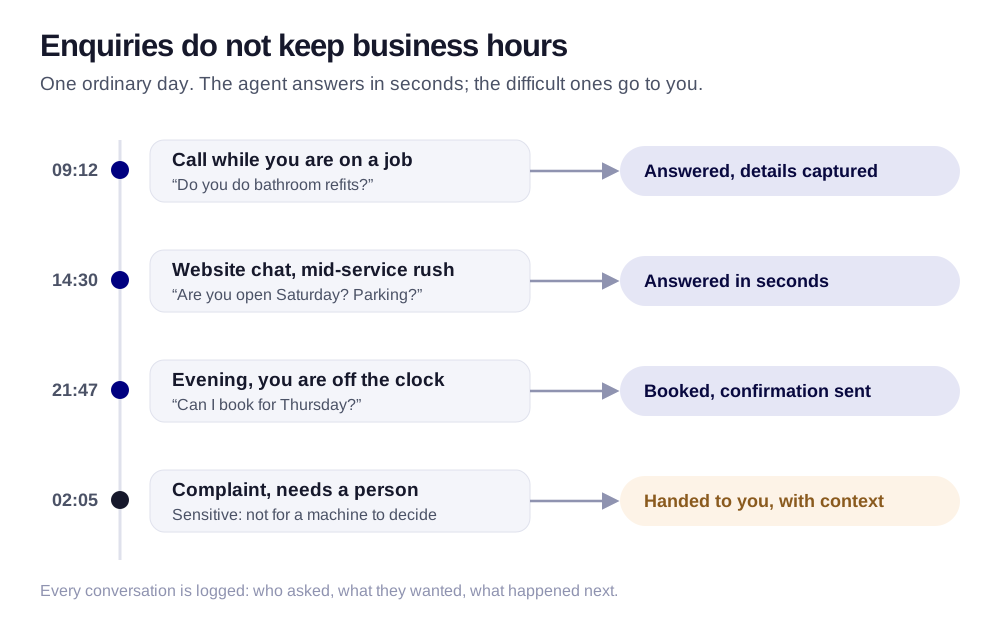
One ordinary day: enquiries do not keep business hours. An agent answers each one in seconds, books what it can, and hands the rest to you.
Somebody finds your business at 9:40 on a Tuesday night. They have one question, maybe two, and they are ready to book. You are asleep, or at dinner, or elbow-deep in the actual work you get paid for. By morning, that person has asked someone else. AI agent is the buzzword attached to fixing this, and like most buzzwords it gets used to sell all sorts of things. So let us be precise about what one actually does.
First, what an AI agent actually is
You have met the old website chatbot: a widget with five buttons and canned replies, helpful right up until you ask a real question. An AI agent is a different animal. It runs on the same kind of AI behind ChatGPT, but it is set up with your information: your services, your opening hours, your policies, your prices if you want, your tone. Ask it something in normal language, in the middle of the night, with typos, and it answers the way a well-briefed employee would.
The word agent matters, because answering is only half the job. A proper agent can also act: take a booking, collect a caller's details and what they need, send a confirmation, and flag the conversation for a human when it should. That is the line between a chatbot that talks and an agent that works.
The real problem it solves: you cannot answer everything
A small business misses enquiries for the most honest reason there is: everyone is busy doing the work. The plumber is under a sink. The clinic is with a patient. The restaurant is mid-service. And a lot of demand arrives outside opening hours anyway, because people search when they are free, not when you are. None of those enquiries announce themselves twice.
~5 min
reply within about five minutes and you are dramatically more likely to reach and qualify a new lead than if you wait even half an hour. Speed to first reply is the single most studied lever in lead response.
Source: the Lead Response Management study (InsideSales / MIT)
That is the uncomfortable arithmetic: it is rarely the quality of your work that loses the lead, it is the gap between their question and your answer. An agent closes that gap to seconds, at 2pm and at 2am, on the day before a holiday, and on the Saturday you finally took off.
What a well-built agent handles in a normal week
1
Answers the questions that repeat
Every business has the same ten questions on a loop: do you do X, how much roughly, where are you, can I come Saturday. The agent answers them instantly and accurately, from information you approved, which also frees you from typing the same reply for the hundredth time.
2
Captures the lead while interest is hot
When the visitor is a potential customer, the agent does what a good receptionist does: gets their name, contact details and what they need, right there in the conversation. Even if nothing else happens until morning, the lead is caught instead of gone.
3
Books, confirms and reminds
Connected to your calendar, the agent offers real available slots, books the appointment and sends the confirmation. Reminders cut the no-shows that quietly eat a service business's week.
4
Hands over to a human at the right moment
A complaint, a negotiation, an unusual request, anything sensitive: a well-configured agent recognises the boundary, says so honestly, and passes the conversation to you with the full context, instead of improvising.
5
Writes everything down
Every conversation is logged: who asked, what they wanted, what happened next. After a few weeks you can see which questions and services people actually ask about, which is marketing information most small businesses never had.
An honest note
An agent is only as good as what you give it. Feed it vague or outdated information and it will give vague or outdated answers, faster. The setup work, deciding what it should say, what it must never promise, and when it hands over, is where the real value is built. That part is done by people, once, and then the agent repeats it perfectly.
What an AI agent is not
A replacement for you. It handles the repetitive front door so your time goes to the work and the conversations that genuinely need a person.
A generic widget you switch on. The value comes from the configuration: your services, your rules, your tone, your calendar. An agent that knows nothing about your business is just a chatbot with better grammar.
Set-and-forget. Prices change, hours change, services change. An agent needs the same occasional upkeep as your website, or it starts confidently telling people last year's truth.
A source of new demand. It converts the enquiries you already get and would otherwise miss. If nobody is finding you in the first place, fix getting found first.
The businesses winning with AI agents are not doing anything clever. They are simply the ones that answer, every time, in seconds.
The Kodable team
How Kodable helps
We build AI agents configured for one specific business: yours. Your services, your rules, your calendar, your tone, in your language and your customers' language, with clear boundaries and a clean handover to you. No generic widget, and no promises an agent cannot keep.
See what an agent could take off your plate
Tell us how enquiries reach you today, in a 15-minute call. We will map what an agent could answer, book and capture for your business, and what should stay human.
Same family of technology, very different setup. ChatGPT knows the internet; an agent knows your business, and only says what you have approved. It also connects to real things, like your calendar and your inbox, which a plain chat window cannot.
Will customers be annoyed they are talking to an AI?
People are annoyed by dead ends, not by software. An agent that answers the actual question at 11pm beats a contact form that replies in two days. Being upfront that it is an assistant, and handing over to a human smoothly, is part of doing it properly.
What happens when it does not know the answer?
A well-built agent says so, takes the person's details, and passes the conversation to you with context. The failure mode to avoid is an agent that guesses; that is a configuration choice, and we set ours to never do it.
Does this work on WhatsApp or only on my website?
The same agent can sit behind several doors: your website chat, WhatsApp, even the follow-up to a missed call. Where it lives depends on where your customers already write to you.
K
The Kodable team
A small studio using AI to help local businesses get found, get booked, and win back their week.
Every week brings another tool you are supposed to be using already. Here is a way to decide what your business actually needs, in one afternoon, using nothing more expensive than a list of the work you already do.
Most small businesses run on a second, unpaid job: the copying, chasing and re-typing that fills the gaps between real work. Here is which parts of it to hand over first, and how to choose without buying six subscriptions you do not need.
Every week without this is a booking someone else is getting.
When a customer searches nearby and books the competitor with a faster site and instant replies, it isn't because they were better. It's because they were easier to find and faster to answer. That's fixable, and it starts with a 15-minute chat that costs nothing.