Small Business Automation: Which Jobs to Stop Doing by Hand First
Most small businesses run on a second, unpaid job: the copying, chasing and re-typing that fills the gaps between real work. Here is which parts of it to hand over first, and how to choose without buying six subscriptions you do not need.
Automation is not a robot taking over your business. It is a set of small handovers: the same task, done the same way every week, moved off your desk.
The jobs worth automating first are the ones closest to money: the first reply to an enquiry, the booking reminder, the quote that never got chased, the review that never got asked for.
Pick by arithmetic, not by excitement. Frequency times minutes times how much it annoys you beats any feature list.
Automation fails for boring reasons: a broken process gets automated as-is, nobody owns it, or it breaks quietly and nobody notices for a month. All three are avoidable.
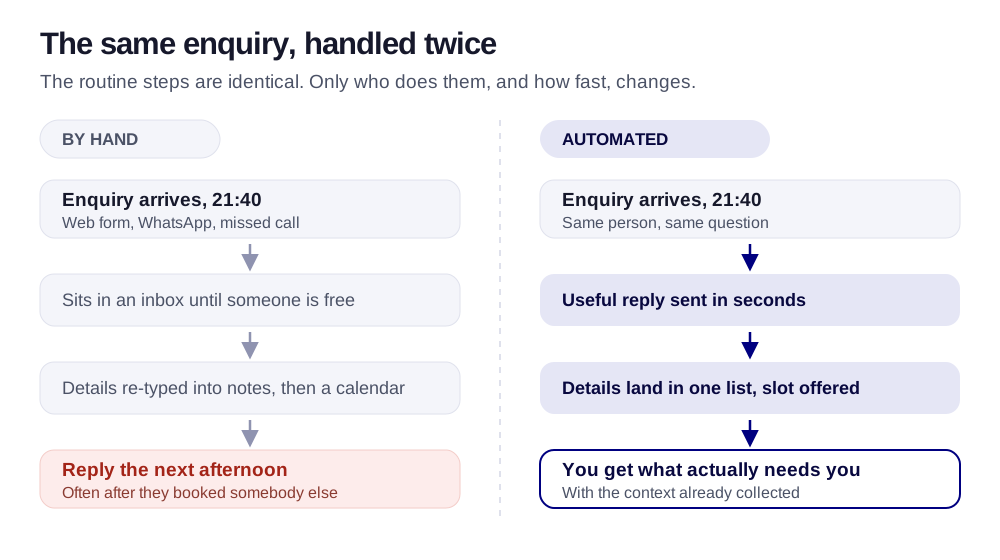
The same enquiry, twice. On the left it waits for a human to be free. On the right the routine part happens immediately and the human gets what is left.
There is the work you get paid for, and then there is the second job. Copying a phone number from WhatsApp into a notes app. Typing the same reply for the ninth time this week. Remembering, at 22:40, that you never sent Tuesday's quote. Nobody invoices for that job, and it still takes hours every week. Small business automation is simply the practice of handing the most repetitive parts of it to software, so that the parts that need you actually get you.
The word carries more drama than it deserves. This is not a factory arm or an algorithm that runs your company. It is a set of small, unglamorous handovers, and the useful question is never "should I automate", it is "which three things first".
What automation actually means at your size
An automation is a rule with a trigger and a consequence. When a form is submitted, send this reply and add the person to this list. When a booking is 24 hours away, send a reminder. When an invoice passes 15 days, nudge politely. That is the whole idea. Everything else is plumbing between the tools you already use.
Which is why the honest test for whether something is a candidate is not technical at all. Ask three questions about the task: does it happen regularly, does it happen the same way each time, and does it need a judgement only you can make? Regular and repeatable with no real judgement in it: automate. Judgement in the middle: automate the parts around the judgement and keep the decision.
A quick sanity check
If you could write down exactly how you do the task, and a competent new hire could follow it on their first day without asking you anything, it is a good automation candidate. If your written instructions end in "it depends", it is not, at least not yet.
Why the first reply is where the money leaks
Before the list, one piece of arithmetic that decides the order. Most small businesses lose more revenue in the gap between an enquiry arriving and someone answering it than anywhere else in their admin. Not because the answer is hard, but because the answer is late.
~5 min
reply within about five minutes and you are dramatically more likely to reach and qualify a new lead than if you wait even half an hour. Speed to first reply is the single most studied lever in lead response.
Source: the Lead Response Management study (InsideSales / MIT)
You cannot beat that clock by trying harder, because the reason you miss it is that you were doing your job. Software has no such problem. That is why almost every list below is really a variation of the same theme: close the gap between something happening and someone hearing back.
Seven automations worth setting up first
1
An instant, useful reply to every enquiry
Not an auto-reply that says "we have received your message". A real one: thanks, here is what happens next, here is roughly when we will call, and here are the two things it helps to know before we do. It buys you hours of goodwill and stops the person shopping around while they wait.
2
Booking confirmations and reminders
A confirmation at the moment of booking and a reminder the day before. This is the cheapest automation in existence and it protects the most expensive thing you own: a slot in your calendar that someone forgot about. Add a one-tap way to move the appointment, because a rescheduled slot is worth far more than an empty one.
3
Quote and invoice follow-up
Most quotes are not rejected, they are forgotten, by both sides. A short follow-up at day three and day ten, and a polite nudge when an invoice goes past its date, recovers work you already did the hard part of. Nobody enjoys chasing, which is exactly why it should not depend on you feeling like it.
4
One place where every lead lands
Enquiries arrive by web form, WhatsApp, phone, Instagram and someone stopping you in the street. If they live in five places they effectively live nowhere. Route them all into one list with the same fields: name, contact, what they want, where they came from. This one is boring and it changes everything else you can measure.
5
The review request you never remember to send
Reviews are the strongest signal you have for both local search and the AI answers that increasingly sit above it. Asking is the hard part, so stop asking manually: trigger the request a day or two after the job is finished, while the customer still remembers being pleased. More on why that matters in getting found when AI answers first.
6
The weekly numbers you assemble by hand
Whatever you export, paste and total every Monday morning: bookings, sales, hours, stock. If you can describe the steps, they can run themselves and land in your inbox before you open the laptop. The value is not the time saved, it is that you actually look at the numbers when they arrive on their own.
7
New-customer onboarding
The pack of things you send every new client: the form, the address and parking, the document you always need, what happens next and when. Sent automatically, in order, it makes a two-person business feel organised in a way competitors are not, and it stops the back and forth that eats a whole day per client.
How to pick your first one
Resist the urge to start with the most interesting one. Start with the one that pays back fastest, which you can find in about twenty minutes with a pen.
1
List what you did twice this week the same way
Not what you think you do. What you actually repeated: the reply you retyped, the number you copied, the thing you looked up twice. Write down five.
2
Multiply frequency by minutes
Six times a week at four minutes is roughly seventeen hours a year, on one small task. Two of those and you have found a working week. This number is usually the surprise.
3
Mark the ones that touch money
A first reply, a reminder, a follow-up on a quote. These do not just save time, they change the outcome. They go to the front of the queue even when they are not the biggest time sink.
4
Ship one, then leave it alone for a month
One automation, running properly, is worth more than five half-built ones. Give it a month, check that it actually fired every time it should have, then pick the next.
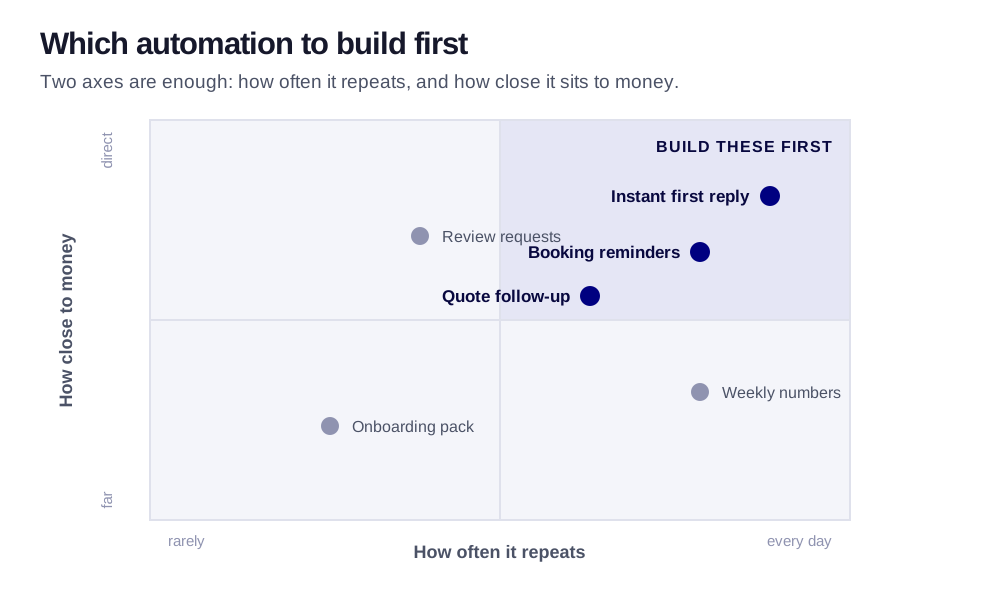
Two axes are enough: how often it repeats, and how close it sits to money. The top right corner is your first automation.
Where automation goes wrong
It is worth naming the failure modes, because they are predictable and none of them are exotic technology problems.
A broken process gets automated as it is. Automation makes a bad workflow happen faster and more often. Fix the steps first, then wire them up.
It fails silently. The integration stops working in March and nobody notices until June, because success looks exactly like doing nothing. Anything automated needs a way to shout when it breaks.
It sounds like a robot to your own customers. Automated does not have to mean impersonal. If the message would embarrass you to send by hand, do not send it a hundred times.
Tool sprawl. Six subscriptions, each doing a slice of one job, none of them talking. The monthly total quietly passes what a single fitted setup would have cost.
Nobody owns it. Every automation needs one person who checks, once a month, that it still does what it was built to do. In a small business that person is usually you, and it takes ten minutes.
Automation, AI agents and custom tools are not the same thing
These three get sold as one blurry product, and choosing badly is expensive. The difference is simple:
An automation follows a fixed rule. Same trigger, same steps, every time. Best for anything predictable: reminders, follow-ups, routing, reporting. That is automations and integrations.
An AI agent handles the unpredictable half: an actual conversation, in normal language, at any hour, that can answer questions and take a booking. It is what you want when the incoming thing is a person with a question rather than an event with a rule. We wrote a plain-English tour of what an AI agent actually does.
A custom tool is for when your business has a process no off-the-shelf product matches, and the spreadsheet has become a liability. That is custom tools and apps.
Most small businesses need the first one, benefit quickly from the second, and only genuinely need the third once the first two are running.
How Kodable helps
We start with the pen-and-paper part: what actually repeats in your week, what it costs you, and which two or three handovers are worth making first. Then we build them into the tools you already use, with a way to tell you when something breaks. No new stack to learn, no six subscriptions. See automations and integrations for how that works in practice.
Find your first three automations
Bring us one ordinary week: how enquiries reach you, what you retype, what you chase. In 15 minutes we will tell you which parts are worth handing over first, and which are not worth touching yet.
Usually not, and you should be suspicious of anyone who says otherwise straight away. Most useful automation is connective: your existing booking system, inbox, spreadsheet and WhatsApp, wired so information moves between them without you carrying it. Replacing a tool is a decision for when the tool itself is the problem, not the default first step.
How small is too small to bother?
A one-person business is often where automation pays back fastest, because there is nobody to delegate to. The threshold is not headcount, it is repetition. If a task happens weekly and takes more than a couple of minutes, it is already worth the arithmetic.
Will my customers be able to tell?
They will notice that you answer quickly, confirm things properly and never lose track of them, which most people read as "well run", not "automated". What gives it away is generic wording and messages that ignore what the person actually asked. Both are writing problems, not technology problems.
What happens when something changes in my business?
Prices change, hours change, services get added. An automation built around one hard-coded detail becomes wrong quietly, which is the worst way to be wrong. Anything likely to change should sit in one place you can edit, and someone should review the set once a quarter. It is a short job if it happens; it is a mess if it never does.
Is automation the same as artificial intelligence?
No, and mixing them up leads to overpaying. Classic automation is deterministic: a fixed rule, no interpretation, and it is the right answer for most admin. AI comes in where language and judgement are involved, such as understanding a question a customer typed at midnight. A good setup uses each for what it is actually good at.
K
The Kodable team
A small studio using AI to help local businesses get found, get booked, and win back their week.
Every week brings another tool you are supposed to be using already. Here is a way to decide what your business actually needs, in one afternoon, using nothing more expensive than a list of the work you already do.
For most local businesses the Google listing gets more visits than the website. It is also the thing most owners set up once and never touch again. Here is what to fill in, what to keep doing, and what to leave alone.
Every week without this is a booking someone else is getting.
When a customer searches nearby and books the competitor with a faster site and instant replies, it isn't because they were better. It's because they were easier to find and faster to answer. That's fixable, and it starts with a 15-minute chat that costs nothing.